Quick Summary
24 Hours, 38 Offsets: How Politics Bent the Clock If th […]
24 Hours, 38 Offsets: How Politics Bent the Clock • UTC: The Reference Point That Is Not a Time Zone • UTC vs. GMT: Why the Distinction Matters
24 Hours, 38 Offsets: How Politics Bent the Clock
If the world followed pure geography, time zones would be simple: 24 equal slices of 15 degrees longitude each, one hour apart, running from pole to pole. Reality is far messier. According to Wikipedia, the global time spread actually covers 26 hours — from UTC-12:00 to UTC+14:00 — because some Pacific island nations moved their position relative to the International Date Line for economic convenience. Meanwhile, political decisions have created over 38 distinct offsets currently in use, including half-hour and 45-minute increments.
A world time zone is a geographic region that follows a uniform standard time, primarily defined by its offset from Coordinated Universal Time (UTC). While the globe is theoretically split into 24 zones based on longitude, political boundaries and local decisions have shattered that tidy model.
UTC: The Reference Point That Is Not a Time Zone
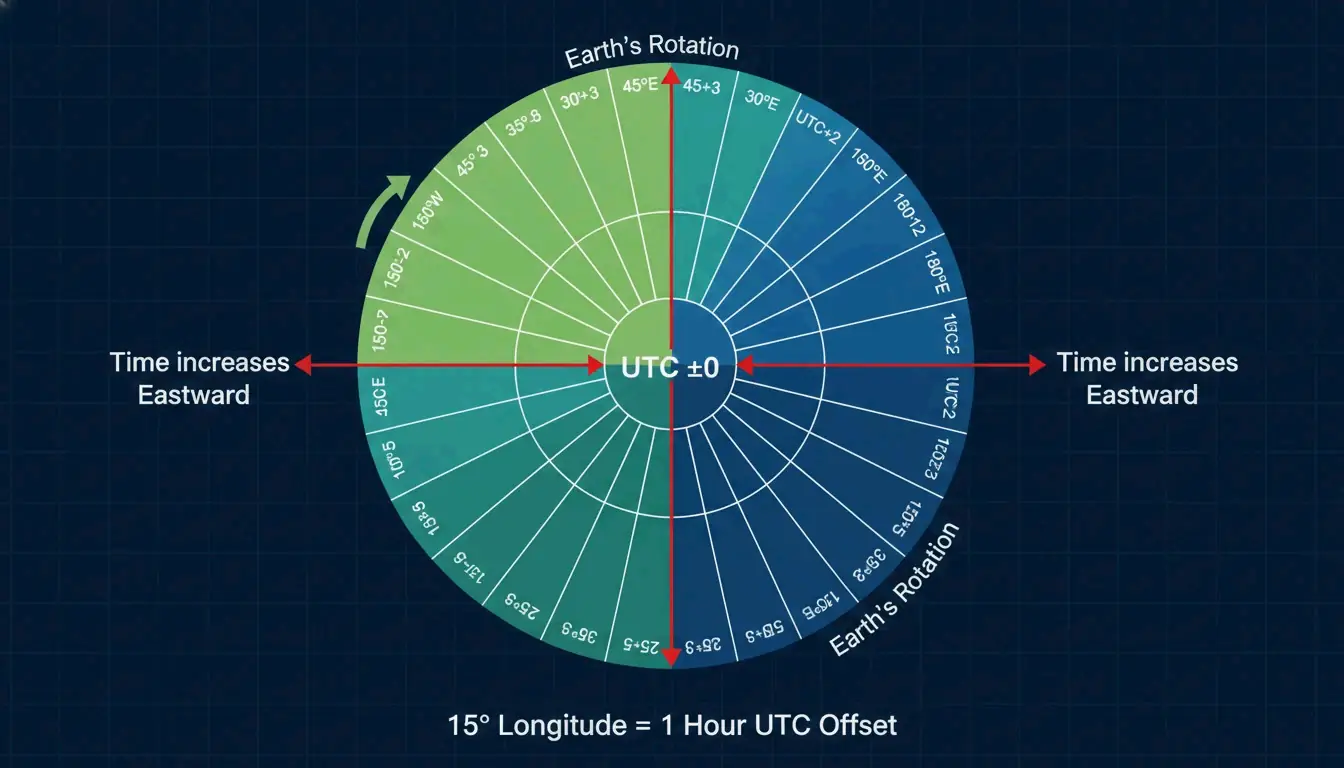
Coordinated Universal Time (UTC) is the high-precision atomic time standard used to regulate clocks worldwide. It is not a time zone itself — it is the reference point from which every other zone is measured. The math is straightforward: Earth rotates 360 degrees every 24 hours, so each one-hour shift covers approximately 15 degrees of longitude.
UTC vs. GMT: Why the Distinction Matters
People often use Greenwich Mean Time (GMT) and UTC interchangeably, but they have different technical roots:
| Standard | Basis | Precision | Usage |
|---|---|---|---|
| GMT | Solar time at the Royal Observatory, London | Based on Earth’s rotation | Traditional, colloquial |
| UTC | Atomic clocks (International Bureau of Weights and Measures) | Nanosecond accuracy | Technology, aviation, Internet |
For your calendar or travel plans, the time is identical. But UTC is what powers global tech infrastructure, Internet protocols, and aviation scheduling. GMT is a historical artifact that happens to land in the same neighborhood.
The Time Zone Champions: France, Russia, and the United States
France: 12 (or 13) Time Zones
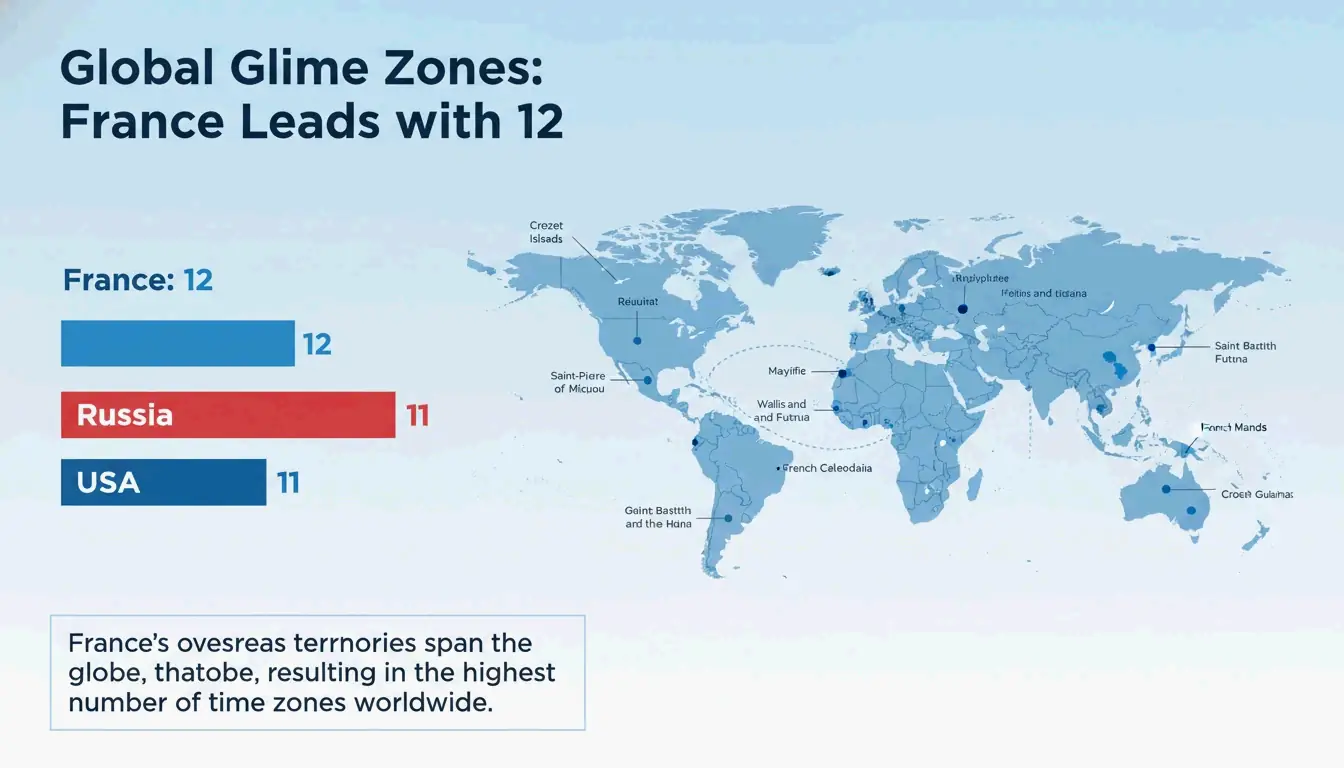
France holds the world record with 12 standard time zones. According to World Population Review, that number reaches 13 if you include France’s claim in Antarctica (Adelie Land). This is not because mainland France is large — it uses only UTC+1 — but because its overseas departments are scattered across every ocean.
French territory stretches from the Caribbean (Guadeloupe at UTC-4) to the Indian Ocean (Reunion at UTC+4) and deep into the Pacific. French Polynesia alone uses three different offsets.
Russia and the United States: 11 Zones Each
Russia and the United States follow with 11 zones each. Russia’s zones are mostly contiguous, stretching across the world’s largest landmass from Kaliningrad (UTC+2) to Kamchatka (UTC+12). The U.S. total is pushed up by Pacific territories like Guam (UTC+10) and American Samoa (UTC-11), separated from the mainland by thousands of miles of ocean.
| Country | Time Zones | Notable Range |
|---|---|---|
| France | 12 (13 with Antarctica) | UTC-10 to UTC+12 |
| Russia | 11 | UTC+2 to UTC+12 |
| United States | 11 | UTC-11 to UTC+10 |
The Remote Work Danger Zone: When DST Goes Rogue
Daylight Saving Time (DST) moves clocks forward an hour in summer to extend evening daylight. For individuals, it is a minor inconvenience. For global teams, it is a scheduling minefield — because not every country observes DST, and those that do often switch on different weekends.
The real Danger Zone occurs during the 2-3 weeks in March and October/November when the U.S. and Europe are out of sync. During these windows, a meeting that normally falls at 9 AM your time suddenly shifts to 8 AM or 10 AM without warning.
Survival strategies:
- Set all international invites to UTC. UTC never changes for DST, removing the guesswork entirely.
- Use real-time tools. Services like World Time Buddy or the Mappr Interactive Map show live offsets including current DST status.
- Double-check in March and October. These are the months when scheduling errors are most likely.
Geographical Oddities: Fractional Zones and the Jagged Date Line
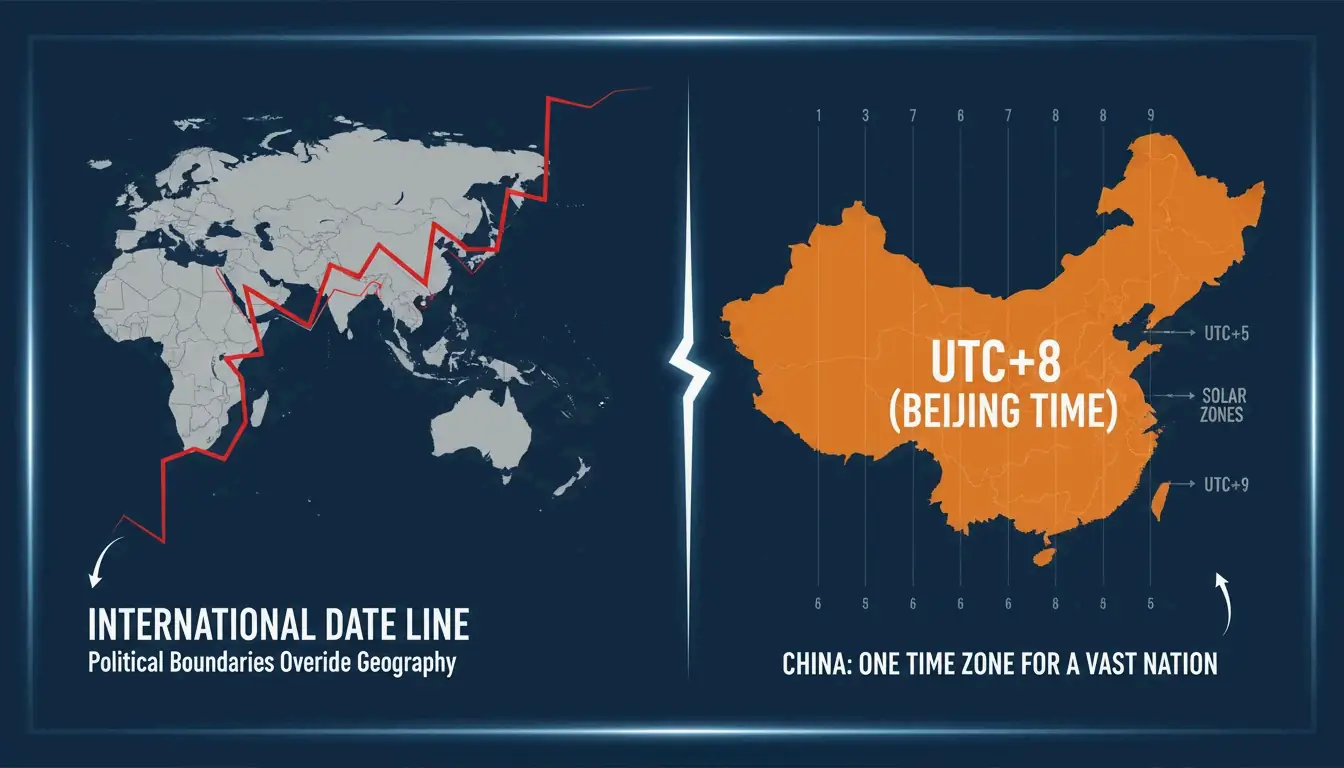
The International Date Line (IDL) sits at roughly 180 degrees longitude and marks where one calendar day ends and the next begins. It is not a straight line — it zags around island groups to keep them on the same date as their economic and cultural neighbors. It is more of a political boundary than a geographical one.
The 30 and 45-Minute Oddities
Some countries use fractional offsets — 30 or 45-minute increments instead of whole hours. These are chosen to align local time with Solar Noon (when the sun is highest) or for political reasons.
| Country/Region | Offset | Reason |
|---|---|---|
| India | UTC+5:30 | Compromise between western and eastern solar time |
| Nepal | UTC+5:45 | 15-minute shift to assert identity separate from India |
| Afghanistan | UTC+4:30 | Alignment with solar position |
| Chatham Islands (NZ) | UTC+12:45 | Local solar alignment for a small population |
| North Korea | UTC+9:00 (was UTC+8:30 until 2018) | Political statement, later reverted |
Why India Uses UTC+5:30
India settled on Indian Standard Time (IST) at UTC+5:30 as a deliberate compromise. The country spans roughly 30 degrees of longitude. By picking a point exactly halfway between two standard hour zones, the government ensured Solar Noon occurs close to 12:00 PM for both Mumbai in the west and the eastern borders. Nepal goes further with UTC+5:45 — a 15-minute shift that also serves as a statement of national identity distinct from its larger neighbor.
China’s Single Zone
China forces a single time zone (UTC+8) across the entire country, even though it naturally spans five solar time zones. The policy was designed to encourage national unity. The practical effect: when it is noon in Beijing, it is still mid-morning in far-western Xinjiang, where the sun does not reach its peak until around 2:30 PM local time.
The IANA Time Zone Database: What Powers Your Phone
Every smartphone, server, and smart device relies on the IANA Time Zone Database (also known as the Olson database). This is a comprehensive digital record of every time zone’s history — every DST change, border shift, and offset adjustment since 1970. When your phone updates its clock automatically after you land in a new country, it is querying this database.
The database is maintained by a community of contributors and is updated multiple times per year as governments change their DST rules or timezone boundaries. It is the single source of truth that keeps global computing synchronized.
Nautical Time: Time Zones at Sea
At sea, ships use Nautical Time, which follows strict 15-degree longitude blocks without regard for political borders. Sailors adjust their clocks in one-hour steps as they cross these lines, keeping ship-time aligned with the sun’s actual position. This system is simpler than land-based time zones precisely because there are no borders to zigzag around.
FAQ
Which country has the most time zones in the world?
France holds the record with 12 standard time zones (13 including its Antarctic claim at Adelie Land). This results from its widely dispersed overseas departments and territories in the Atlantic, Pacific, and Indian Oceans — not from the size of mainland France, which uses only UTC+1.
What is the difference between UTC and GMT?
GMT is a solar-based time tied to the Royal Observatory in Greenwich, London. UTC is a high-precision atomic time standard maintained by international atomic clocks. They represent the same time for everyday use, but UTC is more scientifically accurate and does not drift with Earth’s rotational variations. UTC is the standard used in technology, aviation, and Internet protocols.
Why do some countries like India and Nepal use 30 or 45-minute offsets?
These fractional offsets align local time more closely with Solar Noon — the point when the sun is highest in the sky. They also serve political purposes: India chose UTC+5:30 as a midpoint compromise across its wide longitude span, while Nepal’s UTC+5:45 distinguishes it from India on the world map.
Conclusion
Understanding world time zones requires appreciating the collision between Earth’s rotation, colonial history, political boundaries, and the technical precision of the IANA Time Zone Database. The system is not neat — it is a patchwork of compromises that has evolved over centuries.
For practical navigation: always double-check DST status in March and October, set international scheduling to UTC, and trust the IANA database to keep your devices accurate. The 38 offsets in use today are unlikely to shrink — if anything, politics will keep adding wrinkles to the map.