Quick Summary
The Quartz Crystal Inside Every Computer Inside every s […]
The Quartz Crystal Inside Every Computer • The Core Logic: How Machines Define Time • The Unix Epoch: Counting Seconds Since 1970
The Quartz Crystal Inside Every Computer
Inside every smartphone, server, and laptop, a tiny quartz crystal vibrates at a precise frequency. These hardware oscillators turn physical vibrations into digital ticks, and those ticks become the foundation of every timestamp ever generated. According to Merriam-Webster, a digital timestamp is “an indication of the date and time recorded as part of a signal or file, marking exactly when an event occurred.” But the journey from quartz vibration to a human-readable date involves an elegant chain of abstractions that most developers never think about — and that is a problem, because understanding how it works is the key to avoiding the bugs that break production systems.
Understanding how a time stamp indicates the date and time in digital systems involves tracking elapsed intervals from a fixed reference point. Most systems use the Unix Epoch (seconds since January 1, 1970) or formatted strings like ISO 8601 to ensure precise synchronization across global networks, blockchain ledgers, and modern 64-bit computing environments.
The Core Logic: How Machines Define Time
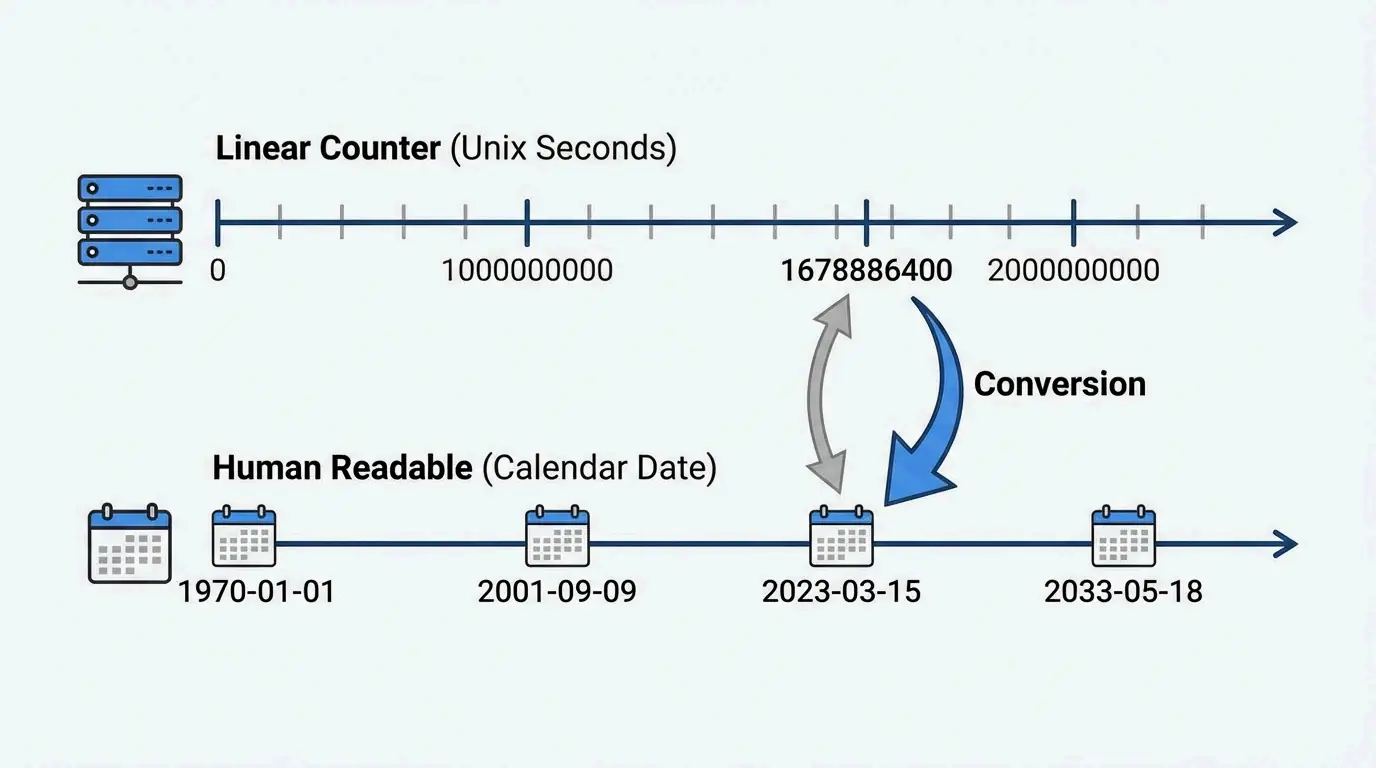
In computing, a timestamp is not a label — it is an operational measurement. While humans rely on descriptive names like “April” or “Tuesday,” digital systems treat time as a continuous linear counter. The foundation is the Epoch, which acts as a universal starting line. Most modern operating systems calculate the current moment by counting the increments that have passed since this reference point.
To keep everything consistent across different hardware and geographies, the world uses Coordinated Universal Time (UTC). As noted by Wikipedia, UTC is an atomic time scale designed to approximate mean solar time at 0 degrees longitude. By using UTC, computers in different time zones synchronize perfectly. The timestamp remains a constant number, and the “local time” displayed on your screen is calculated only at the final rendering step.
The Unix Epoch: Counting Seconds Since 1970
The most common way computers keep time is Unix time — counting the number of non-leap seconds that have passed since 00:00:00 UTC on Thursday, January 1, 1970. As explained by NIXX/DEV, a Unix timestamp is a single integer with no timezone attached. If two systems record the same event at the exact same moment, they produce the same number. No ambiguity.
How these numbers are stored depends on the system’s architecture:
| Architecture | Integer Size | Range | Status in 2026 |
|---|---|---|---|
| 32-bit signed | ~2.1 billion | ~68 years from 1970 | Being phased out |
| 64-bit signed | ~9.2 quintillion | ~292 billion years | Industry standard |
The consequences of staying on 32-bit are not theoretical. The Y2K22 Microsoft Exchange bug demonstrated this in January 2022: a 32-bit overflow caused malware-scanning updates to fail because the date format exceeded 2,147,483,647. It was a dress rehearsal for 2038.
Leap Seconds: The POSIX Compromise
One technical subtlety of Unix time is how it handles leap seconds. Unlike UTC, which adds leap seconds to keep pace with Earth’s slowing rotation, Unix time assumes every day has exactly 86,400 seconds. According to Wikipedia, this creates a tiny “jump” or repeat in the timestamp during a leap second event. The POSIX standard prioritizes mathematical simplicity over astronomical accuracy — a pragmatic trade-off that has served computing well for over fifty years.
The 2038 Problem: Where We Stand in 2026
As of April 2026, the transition from 32-bit to 64-bit time storage is nearly complete in mainstream technology — but gaps remain.
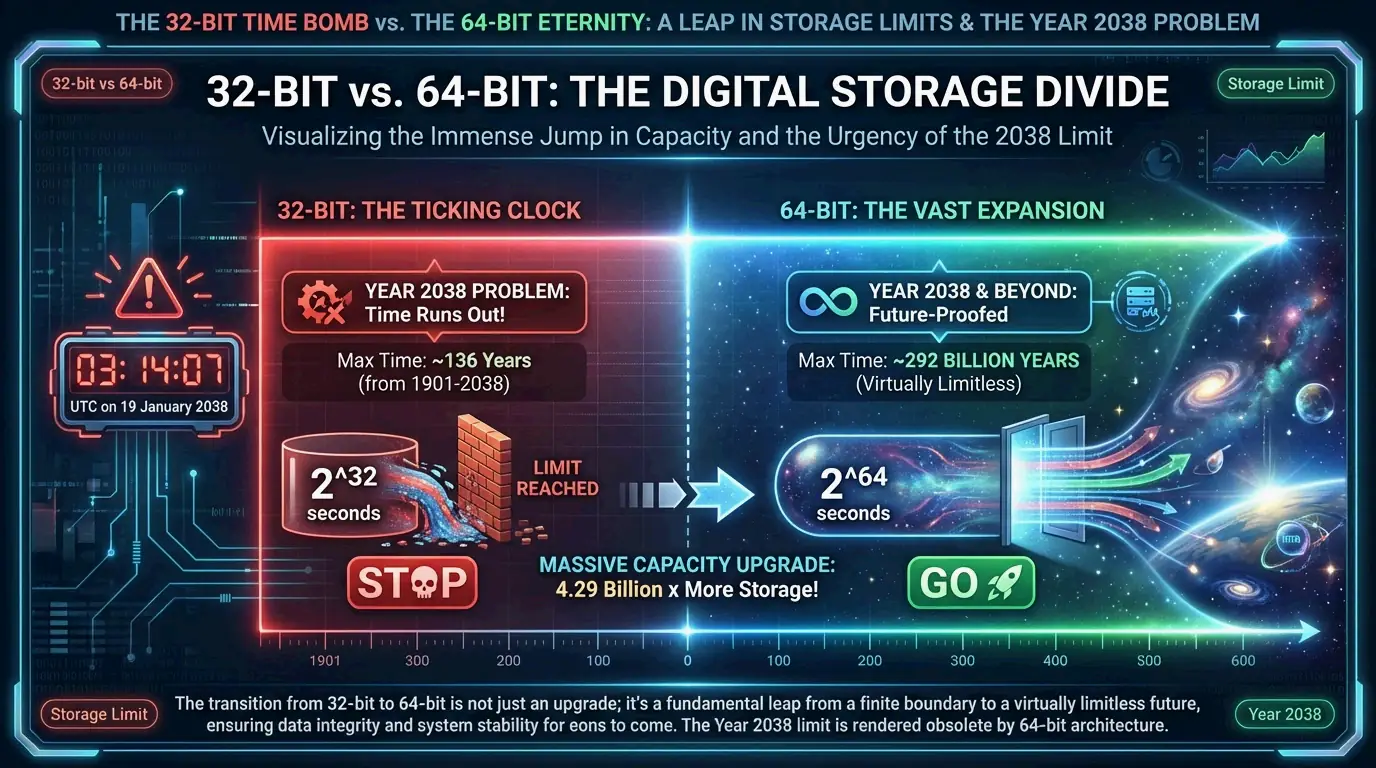
The Year 2038 Problem occurs because signed 32-bit integers have a maximum value of 2,147,483,648. On January 19, 2038, at 03:14:07 UTC, these systems will hit their limit and wrap around to a negative number, effectively making the date jump back to 1901.
Current transition status:
- Linux and Windows: Most modern versions have switched to 64-bit
time_tstructures. - The capacity shift: 64-bit integers extend the range to 292 billion years — longer than the age of the universe.
- Legacy systems: According to Wikipedia, the threat remains real for embedded systems, older IoT devices, and databases using 32-bit fields for historical or future records.
ISO 8601: Making Timestamps Human-Readable
Computers love integers. Humans need structured strings. ISO 8601 bridges the gap. According to Wikipedia, it uses the format YYYY-MM-DDThh:mm:ssZ. The “T” separates date from time. The “Z” (Zulu time) indicates UTC with zero offset.
The format’s killer feature is lexicographic sortability — because the largest unit (year) is on the left, standard string sorting produces chronological order. No date parsing required. This makes ISO 8601 the favorite for cloud computing, APIs, and log aggregation systems.
Converting Timestamps: The Developer’s Daily Task
In 2026, standard libraries handle the conversion seamlessly. In JavaScript:
new Date().toISOString()
// Output: "2026-04-22T14:30:00.000Z"
According to NIXX/DEV, these tools are essential for checking API responses and reading server logs that store raw epoch values. The workflow is always the same: store as Unix integer, serialize as ISO 8601, display in local time.
Blockchain: Why Timestamps Cannot Be Faked
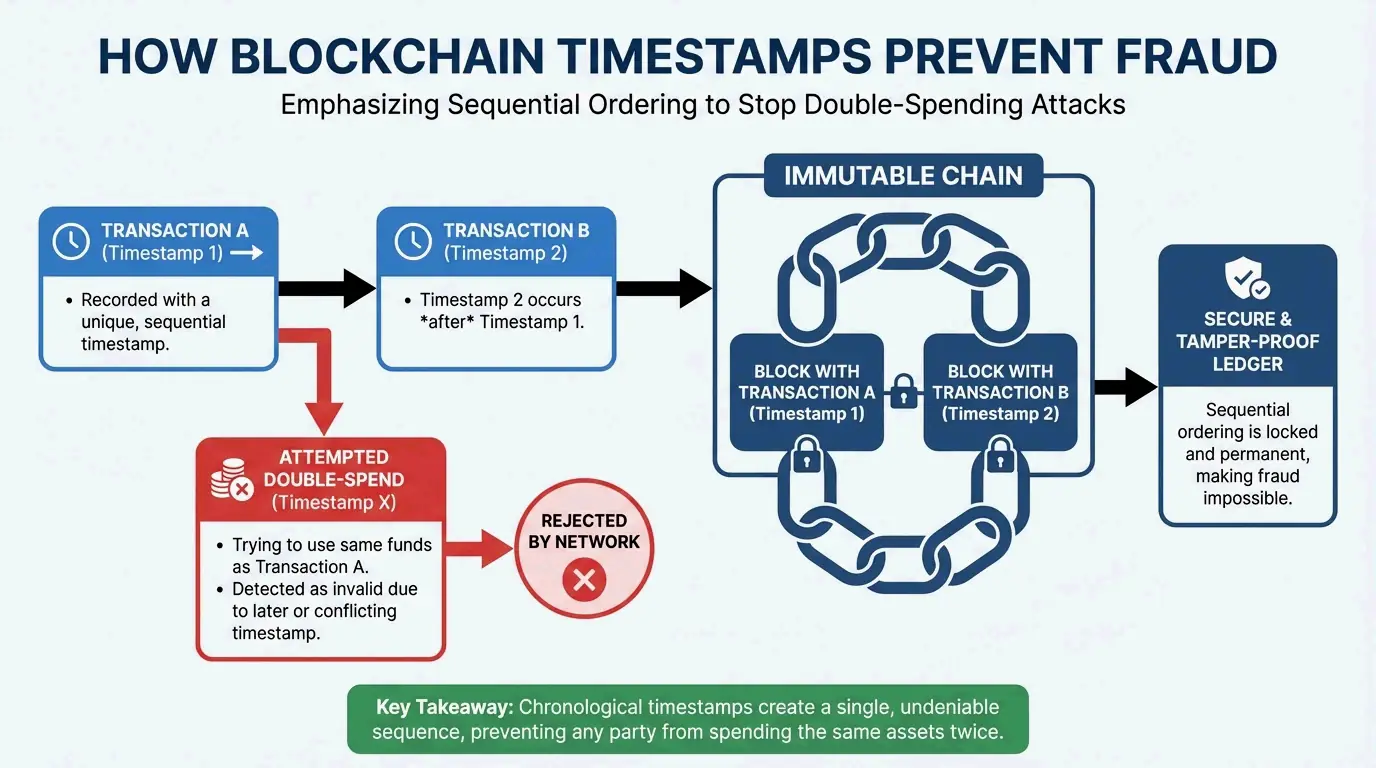
In decentralized systems, timestamps are a primary defense against fraud. As Finst explains, they ensure all transactions are recorded in the right order, creating a history that anyone can verify but no one can change.
Satoshi Nakamoto’s Bitcoin design relied on chronological ordering to solve the double-spending problem. As noted by Finst, “Satoshi Nakamoto… described that timestamps are essential for preventing problems like double spending and for establishing a reliable order of transactions.” In Bitcoin, every new block must have a timestamp later than the median of the previous 11 blocks. This keeps the blockchain moving forward and proves which transaction happened first.
FAQ
What is the difference between Unix Epoch time and ISO 8601?
Unix Epoch time is a raw integer counting seconds since January 1, 1970 — optimized for machine computation and storage. ISO 8601 is a human-readable string format (e.g., 2026-04-22T14:30:00Z) optimized for data exchange, sorting, and display. The best practice is to store as Unix integers and serialize as ISO 8601 for APIs and logs.
Is the Year 2038 problem still a threat in 2026?
For mainstream systems (Linux, Windows, macOS), the transition to 64-bit time_t is nearly complete. The remaining threat lies in embedded systems, legacy IoT devices, and older databases that still use 32-bit fields. Organizations should audit their infrastructure for any remaining 32-bit time storage before 2038.
How do blockchain timestamps prevent double spending?
Blockchain timestamps create a cryptographically secured chronological order for every transaction. When someone attempts to spend the same digital asset twice, the network compares timestamps — the earlier transaction is accepted, the later one is rejected. Bitcoin’s Median Past Time rule ensures that no block can have a timestamp earlier than the median of the previous 11 blocks, preventing miners from rewriting history.
Why does UTC matter for timestamps?
UTC provides an international time standard that stays the same regardless of geographic location. By storing timestamps in UTC, systems across different time zones can synchronize perfectly. Local time conversion happens only at the display layer, preventing the timezone-related bugs that plague systems using local time for storage.
Conclusion
Digital timestamps are the invisible glue of the modern world. They translate raw numbers into synchronized reality using standards like the Unix Epoch and ISO 8601. By counting seconds from a fixed starting point, systems maintain the precise, clear records needed for everything from global stock markets to secure blockchains.
As 2038 approaches, completing the transition to 64-bit integers remains a top infrastructure priority. Developers should audit legacy 32-bit systems now and standardize on ISO 8601 for API data to ensure cross-platform compatibility for decades to come.