Quick Summary
The Crash That Came 32 Years Early In May 2006, AOLR […]
The Crash That Came 32 Years Early • What Is Epoch Time? The Linear Counter That Runs the World • Leap Seconds: The POSIX Compromise
The Crash That Came 32 Years Early
In May 2006, AOL’s server infrastructure ground to a halt. The cause was not a hack or a traffic spike. The software had a “billion-second timeout” setting for database requests. When the system added one billion seconds to the current date in 2006, the total exceeded the maximum value of a 32-bit signed integer — the same limit that will trigger the Year 2038 problem. AOL hit the wall 32 years ahead of schedule, and millions of users lost service.
This was not a hypothetical scenario. It was a preview of what happens when a number runs out of room.
Epoch time — also called Unix time — is a system that tracks time by counting the total seconds elapsed since January 1, 1970, at 00:00:00 UTC. As of May 2026, it remains the standard way to synchronize data across global databases, APIs, and modern coding environments.
What Is Epoch Time? The Linear Counter That Runs the World
Think of epoch time as a simple, linear counter. Computer systems use it to represent any moment in history as a single, large integer. While humans prefer dates with months, leap years, and time zones, computers find integers dramatically easier to sort, compare, and store.
The foundation is the Unix epoch. According to the POSIX.1 standard, this “starting line” is set at 00:00:00 UTC on January 1, 1970. Every second that ticks by adds one to the counter. On May 6, 2026, the Unix timestamp was approximately 1,778,030,894, as tracked by TimeCal.net.
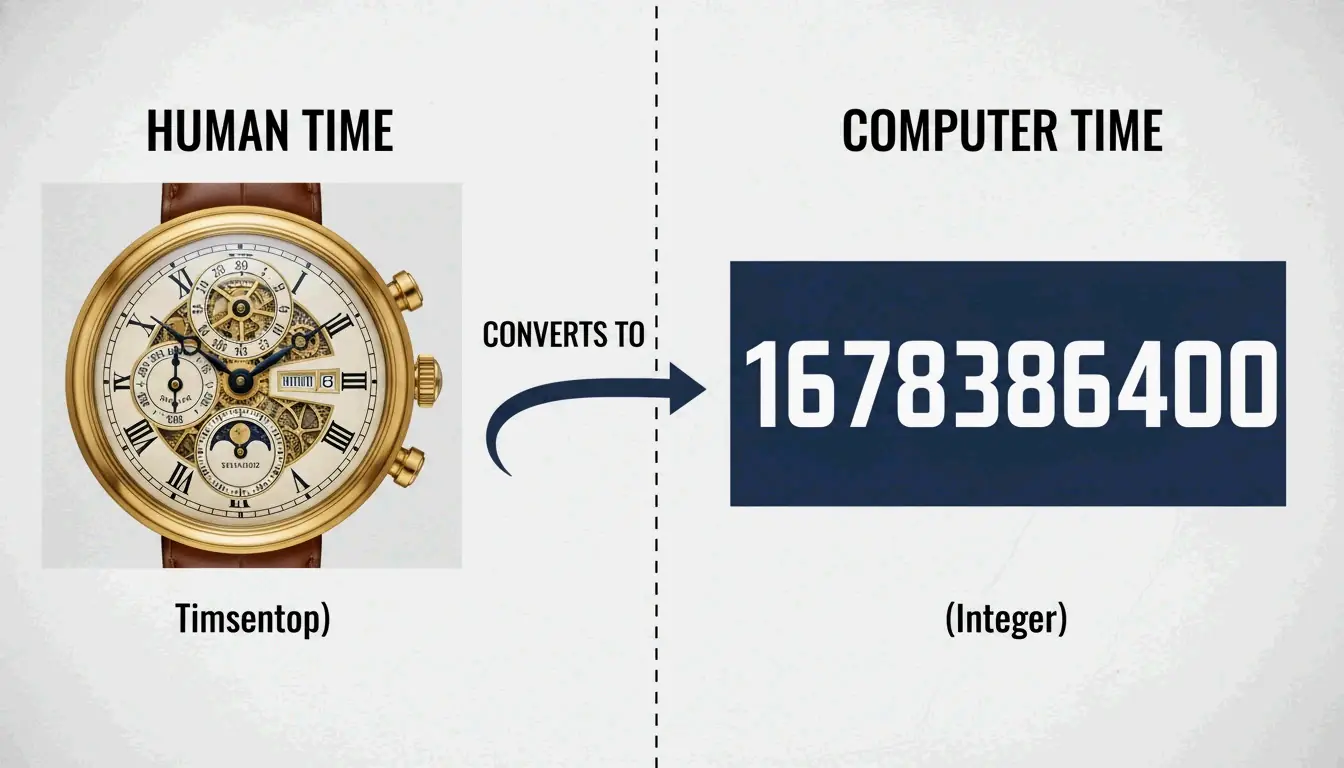
Since it relies on UTC, epoch time ignores time zones entirely. A single timestamp means the exact same moment in New York, Tokyo, or London. This universal nature makes it the hidden backbone for network protocols, file systems like ext4, and cloud databases.
Leap Seconds: The POSIX Compromise
There is one technical quirk. As noted on Wikipedia, Unix time is not a perfect 1:1 map of “atomic time” because it essentially ignores leap seconds. The POSIX.1 standard assumes every day has exactly 86,400 seconds. When UTC adds a leap second, Unix time usually repeats the previous second or “jumps” to stay aligned. This works fine for most applications but may not be precise enough for high-level scientific work requiring sub-second atomic accuracy.
The Developer’s Cheat Sheet: Converting Epoch Time
The most common hurdle for developers is turning these long integers into human-readable dates — and the most common bug is mixing up 10-digit vs. 13-digit timestamps.
As explained by UnixEpoch.net, a 10-digit timestamp counts seconds (standard Unix), while a 13-digit version counts milliseconds. Treat a millisecond timestamp as seconds and your code will think the date is somewhere in the year 55,000.
Language Quick Reference
| Language | Get Current Timestamp | Precision | Digits |
|---|---|---|---|
| JavaScript | Math.floor(Date.now() / 1000) |
Seconds (after division) | 10 |
| JavaScript | Date.now() |
Milliseconds | 13 |
| Python | int(time.time()) |
Seconds | 10 |
| Go | time.Now().Unix() |
Seconds | 10 |
| MySQL | SELECT UNIX_TIMESTAMP() |
Seconds | 10 |
According to PyTutorial, Python’s datetime.datetime.now().timestamp() returns a float where the decimal portion represents microseconds.
The Digit Length Debugging Rule
When debugging an API response, check the digit length first. TimeCal.net points out that backend languages like PHP and Go usually stick to 10-digit seconds. Frontend tools and Java often use 13-digit milliseconds for extra detail. Standardizing everything to the time_t data type — the classic C-based integer for time — is the safest way to keep different systems communicating correctly.
The Year 2038 Problem: The “Epochalypse” Approaches
The Year 2038 problem — sometimes called the Y2K38 superbug or the Epochalypse — is a confirmed, date-certain event. The root cause: systems storing time_t as a signed 32-bit integer can only reach 2,147,483,647. Wikipedia notes that we hit this limit on January 19, 2038, at 03:14:07 UTC. One second later, the counter overflows to a negative number, making affected systems think the date is December 13, 1901.
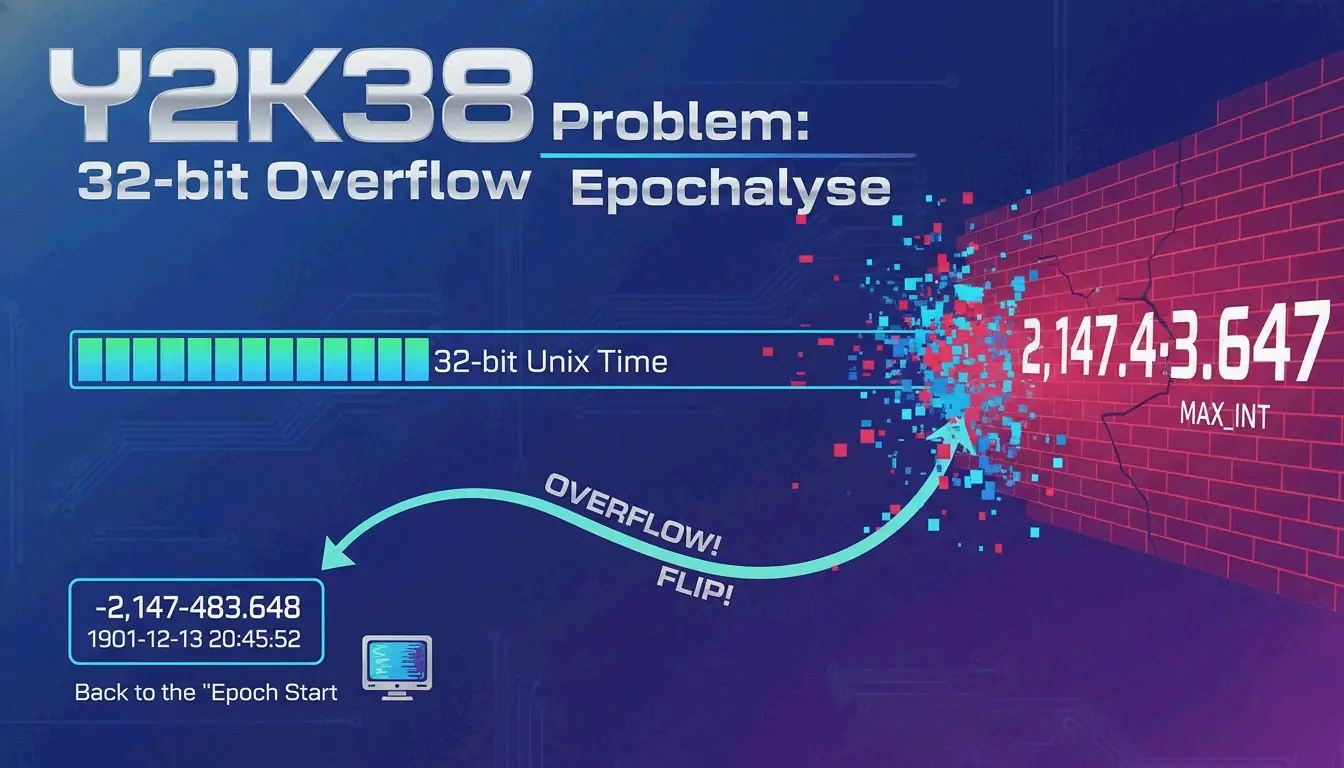
The AOLserver Preview (2006)
The AOLserver crash of May 2006 was not theoretical. According to Wikipedia, the software’s billion-second timeout pushed dates past the 2038 limit, triggering the overflow 32 years early. It proved that the problem does not wait for 2038 — any system that performs date arithmetic into the future can hit the wall today.
The 64-Bit Solution
Most modern systems have moved to 64-bit integers. The capacity expansion is staggering:
| Integer Size | Maximum Value | Date Range |
|---|---|---|
| 32-bit signed | ~2.1 billion | ~68 years (1901-2038) |
| 64-bit signed | ~9.2 quintillion | ~292 billion years |
As The Guardian puts it, 292 billion years is more than 20 times the age of the universe — essentially a permanent fix for human timekeeping. The remaining risk lies in embedded systems, legacy databases, and IoT devices that cannot be easily upgraded.
Leap Seconds: When Your Clock Repeats Itself
The way Unix time handles leap seconds creates a subtle but real problem for high-precision systems. Because POSIX.1 insists every day has exactly 86,400 seconds, there is no way to represent a “61st second” in a minute.
When a positive leap second occurs, UTC moves to 23:59:60. A standard Unix clock often just repeats the timestamp for the first second of the next day:
| TAI Time | UTC Time | Unix Timestamp |
|---|---|---|
| 1999-01-01T00:00:31.00 | 1998-12-31T23:59:60.00 | 915148800.00 |
| 1999-01-01T00:00:32.00 | 1999-01-01T00:00:00.00 | 915148800.00 |
As shown in data from Wikipedia, the timestamp 915148800 becomes ambiguous — it refers to two different moments. This “double-counting” can cause glitches in high-frequency trading or scientific logging where the exact order of events is critical.
FAQ
What is the difference between 10-digit and 13-digit timestamps?
A 10-digit timestamp counts seconds since the epoch — the standard for databases and backend languages. A 13-digit timestamp counts milliseconds, the default for JavaScript and Java. To convert milliseconds to seconds, divide by 1,000. Mixing them up is the single most common timestamp bug in production code.
Can Epoch time represent dates before January 1, 1970?
Yes. Dates before the epoch are represented as negative numbers. For instance, Wikipedia notes that -31,536,000 represents January 1, 1969 — exactly one year before the epoch started. Modern 64-bit systems handle these negative values without issue.
Is “The Epoch Times” newspaper related to Unix epoch time?
No. The Epoch Times is an international media company and newspaper. Unix Epoch time is a technical standard used in computing. They share a name but serve completely different worlds.
Conclusion
Epoch time is the invisible engine of digital timekeeping — a straightforward, number-based system that allows everything from Linux servers to web browsers to stay in sync without timezone headaches. The legacy of 32-bit systems is a real and growing risk as 2038 approaches. For developers, now is the time to audit old code, ensure the switch to 64-bit integers is complete, and standardize on consistent timestamp formats across every layer of the stack.